Make Vocabulary Stick! Engaging, Easy, Research-Based Ideas for Whole Group
Reading comprehension is more than just sounding out words. For a student to understand what they read, they need to know what the words mean. Research shows the words students truly understand make a big difference in how well they perform in school. Specifically, academic language often found in books, instructions, and classroom learning are extremely important.
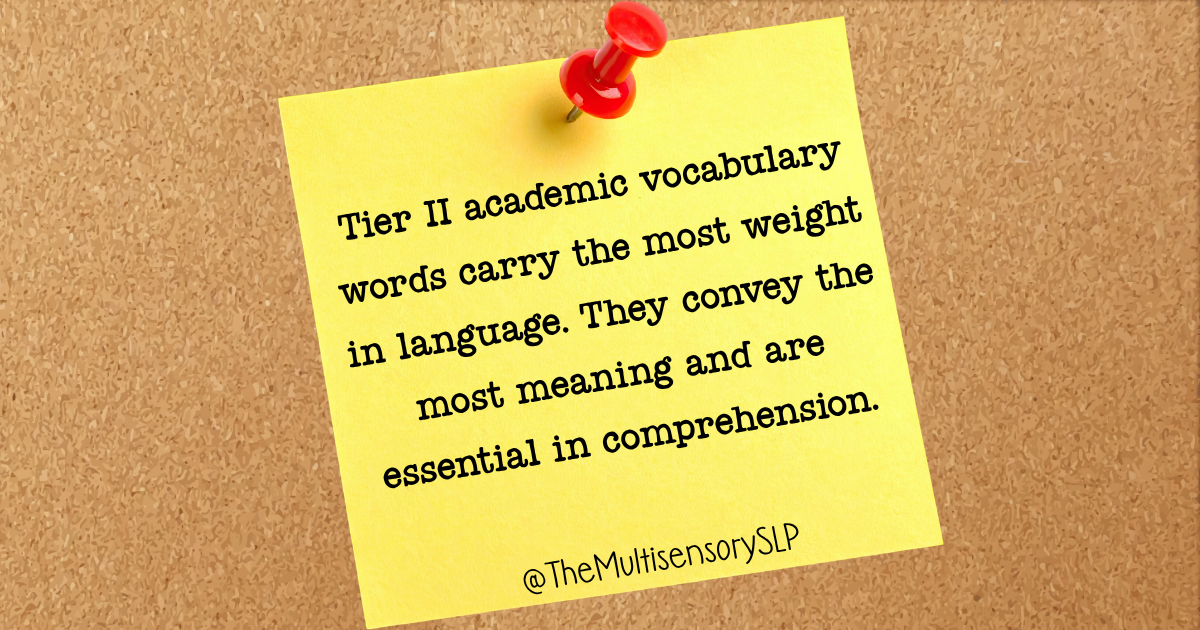
These “school words” are called Tier 2 vocabulary—words like predict, observe, describe, and compare. They appear across subjects, show up on standardized tests, and form the backbone of academic instruction.
How to Teach Academic Vocabulary Effectively
(These are the exact methods used in the Weekly Academic Vocabulary Unit.)
Vocabulary knowledge is a key predictor of reading comprehension, and research offers a clear roadmap for effective instruction. The strategies below are supported by decades of evidence:
1. Explicit, Child-Friendly Definitions
Dictionary definitions are often too abstract for young learners. Research supports using developmentally appropriate explanations paired with relatable, real-life examples. (Hadley et al., 2018)
2. Multiple Exposures Across Contexts
Effective vocabulary learning requires repeated encounters with the target word in varied settings. The unit structure ensures that each word is revisited across multiple days to support long-term retention. (Hadley et al., 2018)
3. Active Engagement with Word Meaning
Students retain vocabulary better when interacting with it through movement, discussion, drawing, or categorization tasks. (Wright & Cervetti, 2017)
4. Written Word Exposure
Viewing the vocabulary word in print supports pronunciation, spelling, and meaning development. Target words are displayed in isolation, and in sentences. (Chambre et al., 2017)
5. Examples and Non-Examples
Providing clear examples and contrasting non-examples helps clarify meaning and prevent misunderstandings. (Stahl, 2006)
6. Connections to Background Knowledge
Linking new vocabulary to prior experiences and familiar concepts builds stronger mental associations. (Parsons et al., 2005)
7. Opportunities for Expressive Use
Instruction should include structured opportunities for students to use new vocabulary orally, through sentence frames, peer dialogue, and guided responses.
These evidence-based strategies are fully integrated into the Weekly Academic Vocabulary Unit, created to support Tier 1 whole-group instruction in early elementary classrooms. The resource is designed for easy implementation and aligns with current best practices from the Science of Reading.
🔗 Click here to preview the Academic Vocabulary Toolkit
Building academic vocabulary in the early years is not optional—it’s essential. With the right tools and instructional framework, every student can develop the language needed to become a strong, confident reader.
Leave a Reply