Category: AAC & Communication

  • Moving On From Requests: Eliciting Labeling During Shared Reading With Nonspeaking or Minimally Speaking Students

    Moving On From Requests: Eliciting Labeling During Shared Reading With Nonspeaking or Minimally Speaking Students

    Have you ever felt like you know what to do with AAC users until you master requests… then you hit a wall. You lose the inherently motivating nature of requests. Now what?

    Well, after requests, we know an excellent next step is commenting. Why? because working to build commenting skills helps support and build

    -joint attention

    -story telling/narrative skills

    -relationships

    -neuroaffirming care

    So how do we do that? If you’re like me, you’ve turned to research. What does it say?

    -> Well that’s the kicker. Most research into treatment approaches with autistic people are focused on teaching requesting. In an open access article (you read that right-you can access this for free, share it with colleagues, print it and bring it to meetings, hand it to teachers, caregivers, etc.) researchers found the most effective prompting, intervention strategies, and length of utterances to target commenting (in 2-16 year olds)… here we go!


    a) Prompting:

    The tried and true least to most prompting hierarchies were the most effective to elicit commenting. This must be SYSTEMATIC to be effective. Interestingly the very least effective method is the simple “what’s this?” questioning. Perhaps most powerful, aided modeling in the absence of all other prompting, was found to be moderately to highly effective (second in line behind systematic least to most prompting hierarchies).

    b) Treatment Method:

    Researchers found that… *drum roll please* shared book reading was the most effective treatment method to elicit commenting. Second in line was play based therapy. Structured activities with intensive teaching were least effective.

    c) Length of Utterance… does it matter?

    YES. Studies that targeted 2 symbol utterances were significantly more effective than those that targeted single word utterances. To me, this seems to make sense. I’d also be more motivated to make a comment about something if I had something to say about it… like little car, sad cat, etc. rather than just using a single word to label, describe, or draw attention to the object. However, it is important to keep this in mind when working with students.

    Literacy, AAC, & a Freebie

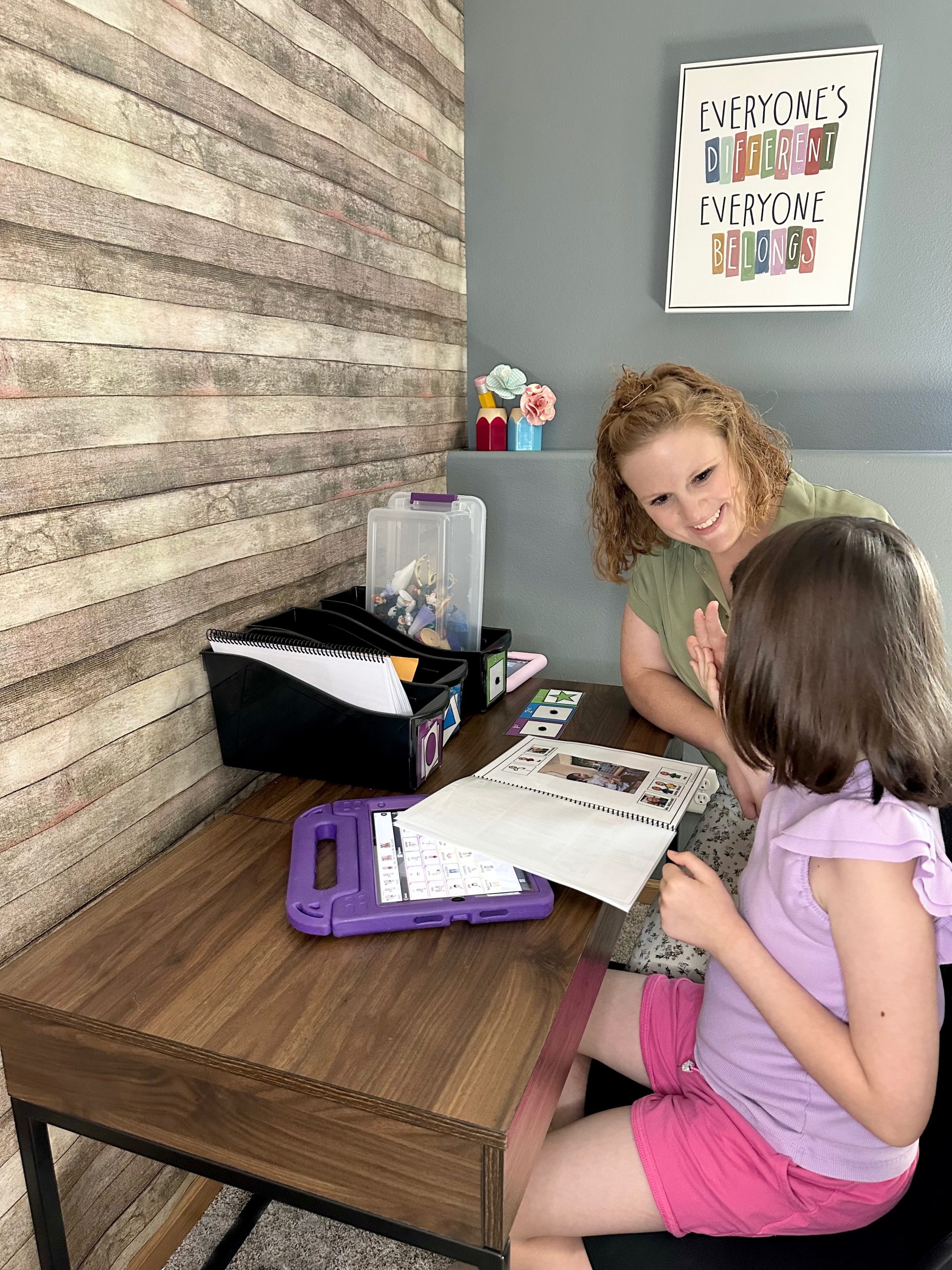
    In summary, shared reading is a research-backed, natural way to grow language skills. Interactive, adapted storybooks provide extra support for students who benefit from multisensory learning. Each page features a large, purposeful image—colorful, engaging, and designed to support attention, vision, and language modeling. If you’d like to try a literacy-based approach with your students, subscribe to get access to a free Word of the Week Kit and other resources today!

    Citation (open access article-free download)

    Spencer, T. D., Tönsing, K., & Dada, S. (2025). Augmentative and alternative communication (AAC) interventions that promote commenting: a systematic review. Augmentative and Alternative Communication. https://doi.org/10.1080/07434618.2025.2477694

  • Why Structure and Interest Matter: Supporting Autistic Learners in School-Based SLP Settings

    Why Structure and Interest Matter: Supporting Autistic Learners in School-Based SLP Settings

    The Shift No One Prepares You For

    If you work in with kids, you’ve experienced this shift.

    A student you once worked with on the floor—engaged, connected, learning through play—is now sitting across from you at a table… and things are different.

    They’re less engaged. Less willing or able to participate. More easily dysregulated.

    And, as we have therapists have been taught to do, we reflect on our session and we think:

    “What changed? This student used to love speech! How can I fix this?”

    You may even falsely think (like I used to) they’re not ready for the harder, more structured tasks as they’re resulting in more dysregulation.

    What Early Therapy Gets Right

    In the early years, therapy often looks very different.

    It’s play-based.It’s flexible. It’s responsive.

    We follow the student’s lead. We build connection. We create shared experiences.

    Because of that, students are:

    • Engaged
    • Regulated
    • Open to interaction

    Learning doesn’t have to be forced—it happens naturally within connection.

    Then the Expectations Shift

    As students get older, everything changes.

    • More academic demands
    • More structured expectations
    • More time at the table
    • More challenging targets
    • Hypothetically there are more paper-pencil tasks

    And for school-based SLPs, this shift happens in real time—with the same students.

    The 5-year-old who learned through play becomes the 8-, 9-, or 11-year-old expected to:

    • Sit longer
    • Attend more consistently
    • Respond more independently
    • Produce more language

    Learning happens within connection.

    Students Didn’t Lose Skills – Demands Changed

    To the untrained eye; we might think, these students simply:

    • aren’t motivated
    • are avoiding work
    • aren’t able to do the work/it’s too difficult

    The issue however, is often something else entirely:

    The conditions that supported their learning changed.

    The Missing Middle: Structure and Interest

    This is where many therapy approaches break down.

    We tend to swing between two extremes:

    • Open-ended, less structured activities that are engaging but hard to build consistency with OR
    • Highly structured tasks that feel rigid and disconnected

    But effective therapy—especially for autistic students and AAC users—requires both.

    Structure Creates Safety

    Structure is often misunderstood as restrictive.

    In reality, structure reduces uncertainty.

    It tells the student:

    • What to do
    • How to do it
    • When it’s finished

    This clarity lowers cognitive load and supports attention.

    For many students, especially those who struggle with regulation or processing demands, structure creates something essential:

    A sense of safety.

    Interest Drives Engagement

    Structure alone isn’t enough.

    You can have a perfectly organized system—but if the content isn’t meaningful, engagement will drop.

    Interest is what pulls the student in

    • High interest topics
    • real-world connections
    • visually meaningful materials
    • familiar routines

    Task Completion Builds More Than Skills

    When students successfully complete structured tasks, they’re building more than academic or language skills.

    They’re building:

    • Endurance
    • Independence
    • Confidence
    • Predictability in routines

    For students who have struggled to access learning, this matters.

    It shifts their experience from:“I can’t do this.”

    to:

    “I know what to do. I can do this.”

    What This Looks Like In Practice

    Effective therapy sessions often include:

    • A predictable structure (task boxes, consistent routines)
    • High-interest, meaningful content
    • Intentional language modeling (including AAC and multimodal communication)
    • Built-in success through scaffolding or errorless learning
    • Ongoing connection between clinician and student These elements don’t compete with each other. They work together to create access.

    As expectations increase across grade levels, our approach has to evolve, but that doesn’t mean leaving the early strategies behind.

    “Play” wasn’t the “easy phase.” It was the foundation.

    The structure isn’t the opposite of connection.

    When done well, it protects it and creates a sense of safety and predictability.

    For The SLP Who Needed This:

    If you’ve ever thought:

    • This used to work… why doesn’t it anymore?”
    • They can do more than this… I know they can.”
    • “I just need something that helps them stay engaged at the table…”

    You’re not missing something.

    You’re seeing the gap.

    When we intentionally balance structure, interest, and connection, we start to close it.

    Research and Framework:

    Errorless Learning — Terrace (1963); Mueller et al. (2007)→ Reducing errors during learning increases success, confidence, and retention.

    Cognitive Load Theory — Sweller (1988)→ Clear structure and predictable routines reduce cognitive demand, allowing more capacity for learning.

    Barry Prizant→ Regulation, connection, and emotional safety are foundational to engagement and learning.

    Zone of Proximal Development→ Learning occurs when tasks are scaffolded just beyond independent ability.

  • Why Core Word Instruction Comes Before Phonics for Minimally Speaking and Nonspeaking Students

    Why Core Word Instruction Comes Before Phonics for Minimally Speaking and Nonspeaking Students

    In ten years of working as a Speech-Language Pathologist, with 7 of those in the schools, the most common question I hear is:

    “Why are you teaching core words instead of phonics?”

    A fair question, phonics is foundational for literacy. After all, districts across the country have recently made the push to the science of reading. We know it matters. In fact, we’ve been saying phonics matters since districts were standing strong with the balanced literacy approach, but that’s a story for a different day. That being said, for many minimally speaking and nonspeaking students, phonics is not the place to start.

    When language is not yet functional, our priority must be building meaning, connection, and communication before we focus on the smallest units of language – phonemes.

    This is not about lowering expectations. It’s about building the right foundation.

    Language Comes Before Letters

    Phonics is built on phonemic awareness – the ability to hear, identify, and manipulate individual speech sounds. But phonemes are abstract. They are the smallest pieces of language.

    For many of our learners, even the largest, most concrete parts of language are still difficult to comprehend.

    If a student is not yet using language to:

    • request
    • protest
    • comment
    • connect
    • regulate
    • share attention
    • express intent

    Then phonics becomes an extremely high-level cognitive task.

    We cannot expect students to break words into sounds if they do not yet understand that words carry meaning.

    Language development research has shown for decades that children learn language top-down, not bottom-up. They learn meaning before form, function before structure, and whole words before sounds (Bloom, 2000; Tomasello, 2003; Bruner, 1983).

    Language is rooted in social interaction, connection, and shared attention. Sounds only make sense once language itself makes sense.

    Why Core Words?

    Core words are high-frequency, flexible, and powerful. They appear across environments, activities, and communication partners.

    Words like:go, stop, want, help, more, not, in, on, here, look, that, you, I

    These words allow students to:

    • express needs
    • build relationships
    • regulate emotions
    • participate in learning
    • gain autonomy

    Most importantly, they give students a reason to communicate.

    Research consistently shows that early AAC intervention focused on core vocabulary supports expressive language development, syntactic growth, and social participation (Beukelman & Light, 2020; Romski & Sevcik, 2005; Boenisch & Soto, 2015).

    Core words are not “easier” words – they are more powerful words.

    Whole Words Before Sounds

    For many learners with complex communication needs, instruction must be concrete, meaningful, and functional.

    Whole words are easier to map onto meaning than abstract sounds. This mirrors typical language development. Children understand words long before they can analyze phonemes. Vocabulary growth predicts later reading success, and language comprehension drives decoding (Scarborough, 2001; Catts et al., 2006).

    Scarborough’s Reading Rope clearly shows that language comprehension and word recognition develop together – but comprehension is the driver. Without comprehension, decoding has no purpose.

    Let’s put it this way; phonics without language is just sound.

    This Is a Team Decision

    This approach is not about replacing phonics. It is about sequencing instruction developmentally.

    Phonics is coming. Letter-sound correspondence is coming. Decoding is coming.

    But only after language has a purpose.

    That is why collaboration matters. SLPs, special educators, classroom teachers, families, OTs, and behavior specialists all bring critical pieces to the table. Research shows that integrated, team-based AAC intervention leads to stronger language outcomes than isolated therapy alone (Romski et al., 2010; Kent-Walsh et al., 2015).

    When teams understand the why, implementation becomes stronger and outcomes improve.

    Advocacy Is Part of the Job

    This is still a newer paradigm for many schools.

    Most teachers were trained in literacy models that did not account for AAC users, minimally speaking students, or neurodivergent learners. So yes — you will need to explain yourself. You will need to answer questions. You will need to advocate.

    But you are also the most qualified person in the room to do it.

    Our students deserve instruction that matches how their brains learn.They deserve access to language now – not someday.

    The Bottom Line

    We teach core words first because:

    • Language is meaning before sound
    • Communication is connection before decoding
    • Regulation is required for learning
    • Functional language builds literacy readiness
    • Whole words come before phonemes

    Phonics matters. But language comes first.

    And for our minimally speaking and nonspeaking students, core word instruction is not a detour from literacy – it is the bridge to it.